What Does It Really Take to Protect Nature? Lessons from Canada's Conservation Champions
Reflections from the Canadian Wildlife Federation's inaugural True North Wildlife Conservation Awards

Photo by Owen Wiseman
Last Friday evening, I found myself at Ottawa's Canadian Museum of Nature, surrounded by people who have dedicated so much of their lives to protecting the natural world. Conservation biologists, educators, journalists, Indigenous knowledge holders and advocates. People working to save species from extinction, introduce children to the outdoors, and bring attention to parts of the natural world most of us barely notice.
I was there to attend the Canadian Wildlife Federation's inaugural True North Wildlife Conservation Awards, held on October 23, 2026. Six individuals and organizations were recognized for their contributions to conservation across Canada.[1]
The evening opened with a land acknowledgement from Elder Fred McGregor, an Algonquin Elder and Knowledge Keeper from Kitigan Zibi Anishinabeg, and featured a wonderful performance by jazz vocalist Juliet Dunn.
What stuck with me, though, was the extraordinary range of work being recognized.
I spend much of my professional life talking about the relationship between nature and human health. How green space supports our wellbeing, why healthy ecosystems matter, and why we should treat nature as essential public health infrastructure.
We can't keep talking about what nature does for us without talking about what we're doing for nature.
Conservation Looks Different Than You Might Think
When we hear conservation, Canadians typically picture national parks. Sometimes it’s endangered animals or scientists working in remote wilderness. But this year's recipients demonstrated just how much broader conservation really is.
Consider the Learning from Lake Sturgeon Youth Advisory Group, recipients of the Youth for Wildlife Conservation Award. In northern Ontario, Moose Cree youth are helping monitor lake sturgeon in the North French and Mattagami rivers. Working alongside Elders and conservation partners, they're combining Indigenous Knowledge with scientific approaches to protect these remarkable fish.[1]
Lake sturgeon can live for more than a century. It was so meaningful to see youth protecting an animal that could outlive them. An investment in a future they may never fully see.
Then there's Colin Harris, founder of Take Me Outside, who received the Nature-based Education Champion Award. His work, and that of the organization, focuses on getting children outside to learn. Unfortunately, when so much of childhood unfolds indoors, helping young people develop relationships with nature is hardly a small undertaking.
I've written before about how childhood experiences in nature can influence wellbeing, learning, development and our connection to the environment. But there's another angle. How can we expect future generations to protect places they've never had the opportunity to know?
Protecting the Species We Almost Never See
One recipient I was excited about was Mycosphaera, recognized with the Conservation Innovation Award. Founded in 2025, Mycosphaera is Canada's first non-profit organization dedicated exclusively to fungal conservation.
Fungi!
Not bears, whales or butterflies. Mushrooms, moulds and the enormous diversity of fungal organisms living beneath our feet. Through field inventories and genomic research, the team has documented more than 100 species previously unrecorded in Quebec or potentially new to science.[1] Think about that! We're still discovering organisms in Canadian ecosystems that haven't been formally documented. Some may already be threatened before we've even learned what they are.
Fungi are essential to decomposition and nutrient cycling. Mycorrhizal fungi form relationships with plant roots, helping plants access nutrients and water. Funding has historically focused overwhelmingly on animals and plants, because frankly, it's difficult to protect something when we don't even know it's there.
When Conservation Becomes a Race Against Time
Wildlife Preservation Canada, recipient of the Wildlife Impact Award, has spent more than four decades preventing species from disappearing. Its breeding and reintroduction programs have supported species including the Eastern Loggerhead Shrike, Burrowing Owl, Swift Fox and Oregon Spotted Frog.[1] These programs require painstaking work, sometimes spanning decades. And while they're essential for species already facing extinction, there's an uncomfortable reality worth acknowledging.
We often celebrate the extraordinary efforts required to bring a species back from the brink without giving nearly enough attention to the human decisions that pushed it there.
Captive breeding and reintroduction can help, but they're rarely substitutes for protecting functioning ecosystems before they're degraded.
Prevention matters in conservation just as much as it does in healthcare.
- Owen Wiseman
As a clinician, the parallel is impossible to ignore. We understand the importance of intervening before someone's health deteriorates. Why shouldn't we apply the same thinking to the ecosystems supporting our communities?
The People Who Help Us Pay Attention
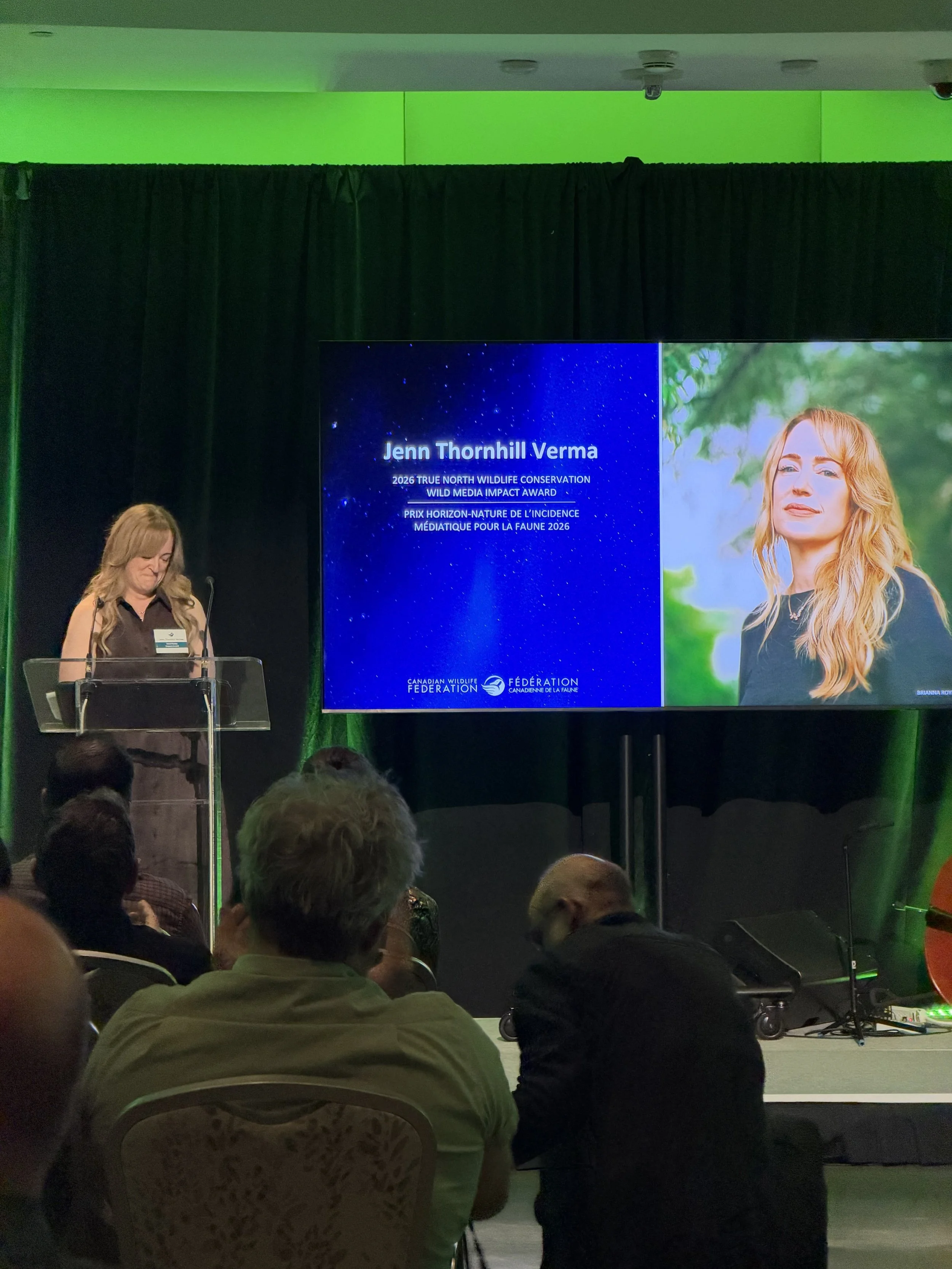
A presenter standing at a transparent podium during the 2026 True North Wildlife Conservation Awards, beside a large screen displaying Jenn Thornhill Verma's photograph and recognition as recipient of the Wild Media Impact Award. Photo by Owen Wiseman.
Now, not everyone protecting wildlife works in a forest or laboratory.
Jenn Thornhill Verma, recipient of the Wild Media Impact Award, was recognized for her investigative reporting on the endangered North Atlantic Right Whale. Her Entangled series in The Globe and Mail examined the threats facing these animals, including fishing gear entanglements, vessel strikes and changing ocean conditions.[2]
Good journalism translates complicated scientific and policy issues into stories people can understand. If the evidence never reaches the public, its influence remains sparse. Much like the ‘impact factor’ of scientific and medical journals.
That's something I think about often in my own work. Whether discussing urban heat, nature prescriptions or biodiversity, the challenge isn't always a lack of evidence. Sometimes it's helping people understand why that evidence matters.
Another moving recognition was the Conservation Leadership Award, presented posthumously to Dr. Sheila Colla. A conservation biologist and York University professor, Dr. Colla dedicated her career to protecting native bumble bees. Her research helped document the decline of species such as the Rusty-patched Bumble Bee, and she co-founded Bumble Bee Watch, which invites the public to contribute observations to pollinator research.[3] Dr. Colla passed away in 2025, but her contributions continue through the people she inspired.
What Does Any of This Have to Do With Human Health?
Quite a lot, actually.
I regularly write nature prescriptions for patients to support their physical and mental wellbeing. But the benefits we receive from nature depend, at least partly, on the health of the ecosystems around us. A park with mature trees, healthy soils, native vegetation and diverse wildlife offers a different ecological experience than a manicured lawn. Both provide opportunities to get outside, but they're not ecologically equivalent.
We should also be asking what kind of nature people are accessing, and whether those ecosystems are healthy enough to support wildlife and people over the long term.
Restoring a wetland can protect wildlife while supporting flood regulation and water quality. Urban trees provide habitat while helping reduce exposure to extreme heat. Native plants support pollinators while making neighbourhoods more ecologically resilient.
These benefits aren't always perfectly aligned, but our health and the health of the natural world are more closely connected than our policies and institutions often acknowledge.
A Reason to Be Hopeful
As I reflected on the evening, I kept returning to something I've explored in my writing about Peter Kahn’s concept of environmental generational amnesia. Each generation develops its understanding of a healthy environment based largely on what it experiences growing up. As ecosystems deteriorate, those diminished conditions can gradually become our expectations of what's normal. A river without its native fish may still look beautiful. A forest missing much of its fungal diversity may still appear perfectly healthy (for a time). We're not always aware of what we've lost.
This year's award recipients are pushing against that. They're documenting overlooked species, restoring threatened populations, introducing young people to nature and making environmental challenges visible.
They're helping us pay attention. And that's part of why I left the evening feeling hopeful. Despite the constant stream of discouraging environmental news, people are doing remarkable work.
I'm grateful to the Canadian Wildlife Federation for bringing these stories together and recognizing the people behind them.
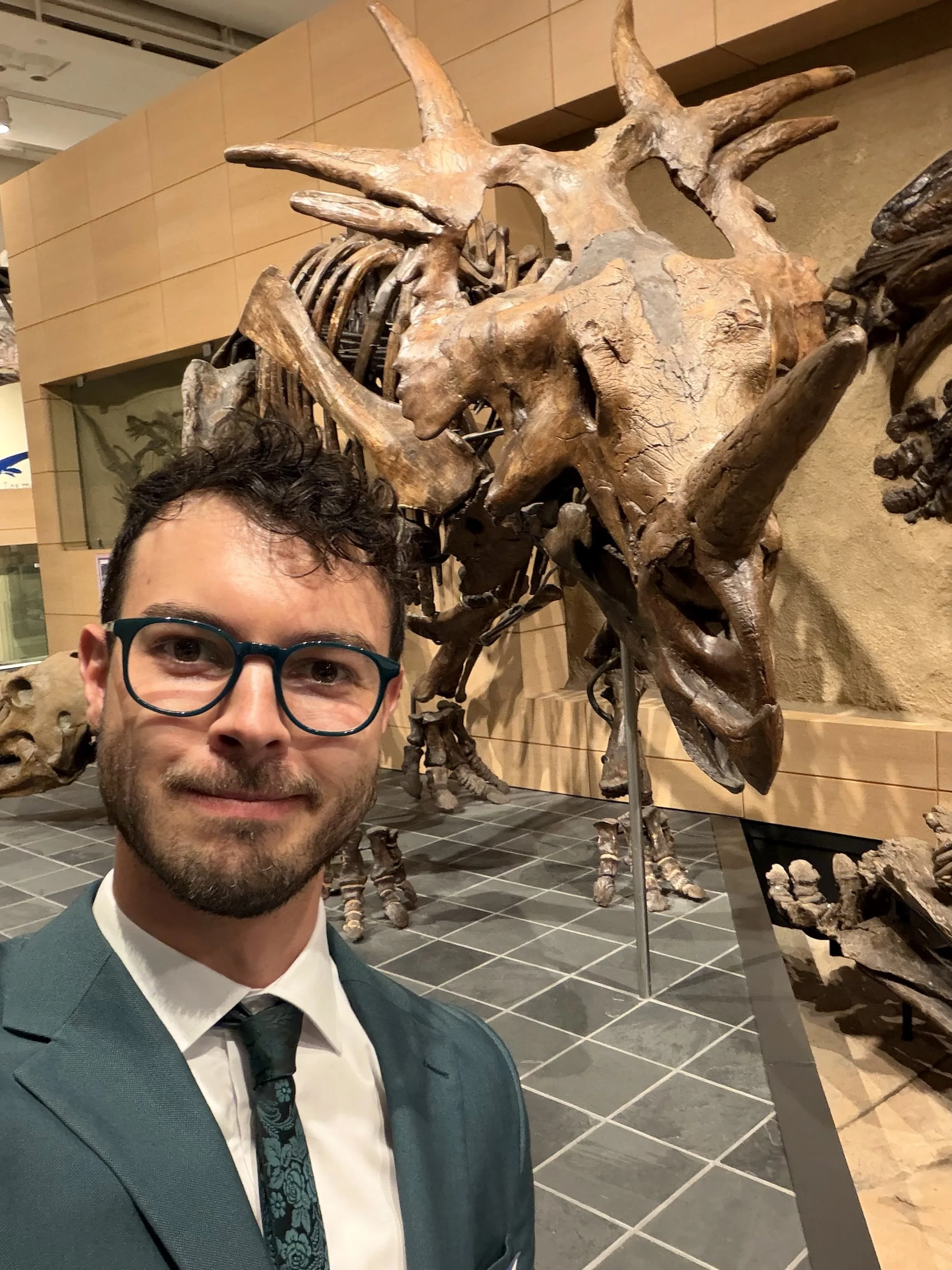
And yes, I also managed to catch up with an old friend at the museum. A Triceratops, to be precise. We hadn't seen each other in about 75 million years, but picked up right where we left off.
Jokes aside, standing beside an animal that disappeared millions of years ago felt like a fitting way to end an evening devoted to conservation. Extinction is part of Earth's natural history. But today's rapid biodiversity losses are being driven by human activity.
That means we have both a responsibility and an opportunity to change the trajectory.
References
Canadian Wildlife Federation. (2026, October 21). National conservation awards shine a spotlight on collaborative efforts to connect Canadians to nature and save species on the brink of extinction. https://cwf-fcf.org/en/news/releases/2026/NATIONAL-CONSERVATION-AWARDS-SHINE-A-SPOTLIGHT-ON-COLLABORATIVE-EFFORTS-TO-CONNECT-CANADIANS-TO-NATURE-AND-SAVE-SPECIES-ON-THE-BRINK-OF-EXTINCTION.html
Canadian Wildlife Federation. (2026). Wild Media Impact Award: Jenn Thornhill Verma. https://cwf-fcf.org/en/explore/what-you-can-do/awards/winners/2026/wild-media-impact-award.html
Canadian Wildlife Federation. (2026). Conservation Leadership Award: Dr. Sheila Colla. https://cwf-fcf.org/en/explore/what-you-can-do/awards/winners/2026/Conservation-Leadership-Award.html